
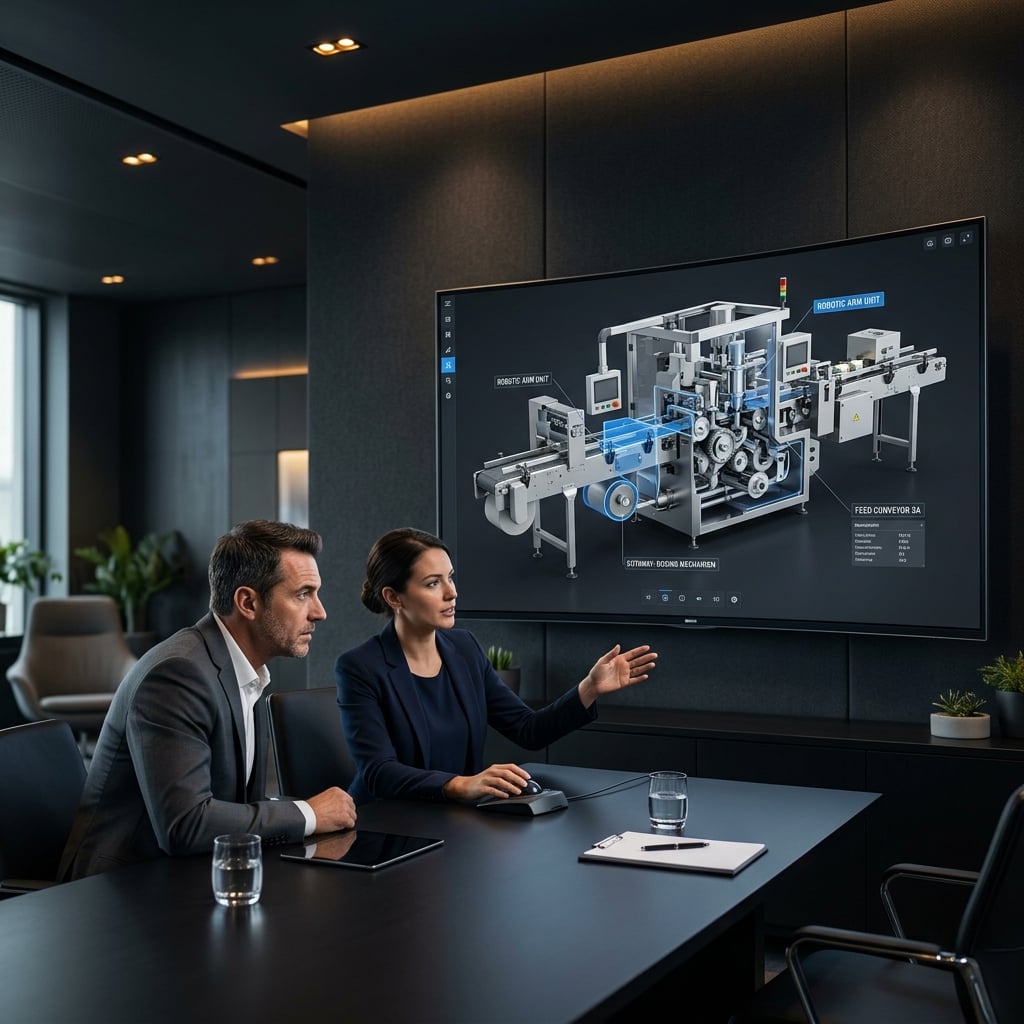
Interactive 3D machinery simulation demonstrating user engagement and advanced technology

How Interactive 3D Visualization Solutions Transform Industrial Training and Sales: Ignite Efficiency and Boost Conversions Now

By Chan Park, SuperBot Industrial

Interactive 3D visualization solutions are revolutionizing industrial training and sales by enhancing user engagement and providing immersive experiences. These technologies allow organizations to bridge the gap between complex concepts and practical understanding, thus improving operational efficiency and boosting sales conversions. In this article, we will explore how interactive 3D visualizations are streamlining industrial training processes and how they empower sales teams to showcase products dynamically. Many companies face challenges such as high onboarding times for new employees and difficulties in demonstrating product advantages effectively. This article will address these issues and unveil the transformative potential of these visualization solutions, delving into aspects such as training efficiency, sales impact, and the key features of industrial digital twin technology.

Why Choose Interactive 3D Visualization for Industrial Training?

Interactive 3D visualization tools are increasingly favored in industrial training due to their ability to deliver engaging and efficient learning experiences. By allowing trainees to interact with complex data and processes in a virtual environment, these tools facilitate a deeper understanding and retention of material compared to traditional methods. Companies are turning to these visual tools as they significantly accelerate onboarding processes, decrease training costs, and improve knowledge retention by creating interactive learning environments that cater to various learner needs.

How Do 3D Training Tools Slash Onboarding Time by 30%?

3D training tools can reduce onboarding time by an impressive 30%, primarily through immersive and engaging training experiences. This approach enables companies to optimize the learning curve for new employees, as they can practice in simulations that mirror real-world scenarios without the risk of actual operational mistakes. Additionally, by integrating interactive elements, trainees often demonstrate increased retention rates, fostering efficient learning.

What Makes Virtual Reality Training So Effective for Industry?

Virtual reality (VR) training is notably effective in industrial contexts due to its immersive capabilities. By simulating environments where safety can be thoroughly addressed, employees can engage in realistic practice scenarios. Industries, particularly in manufacturing and healthcare, benefit from VR applications as they allow for safe training in high-stakes situations. Engagement through immersive experiences greatly enhances information retention, solidifying the learning objectives much more effectively than traditional classroom settings.

Further research underscores the critical role of VR in transforming warehouse safety training, emphasizing simulation realism and immersive interaction as key factors for effectiveness.

Transforming Warehouse Safety Training and Auditing with VR

This study investigates how virtual reality (VR) can transform safety training, risk management, and auditing techniques in warehouse environments, using a mixed-methods approach to deliver practical guidance for industry and VR developers. The analysis applies four phases. The first phase involves observational studies to identify current safety practices, risk management strategies, and audit techniques. Semi-structured interviews with 15 safety experts for empathy mapping and the Delphi Technique with 10 experts to populate the 9-Window framework, assessing training needs and VR integration. The third phase utilizes critical thinking (CT) questions to analyze VR features, and the fourth phase applies the Analytic Hierarchy Process (AHP) to rank VR feature priorities based on their impact and feasibility. Observation findings indicate significant gaps in current safety practices and safety training. Semi-structured interviews and CT discussions demonstrate that VR training significantly enhances safety skills and auditing capabilities and fosters proactive risk management. Immersive VR allows trainees to utilize VR features, such as simulation of misplaced items, risk identification, voice instructions, interaction, and navigation, which were emphasized as crucial components. Furthermore, AHP results show that simulation realism and immersive interaction are the most critical factors for effective VR safety training. Overall, the study highlights VR training as a valuable tool for designers and users in enhancing warehouse safety management, auditing skills, and risk management practices. However, limitations include the need for broader risk scenario training in VR. Future research should quantify training effectiveness and compare it with conventional methods.Virtual reality safety training and auditing in warehouse environments: AHP and critical thinking approach, 2025

How Interactive 3D Visualization Powers Sales with Impactful Demos

Interactive 3D visualization enhances sales by empowering sales teams to create compelling product demonstrations that resonate with potential customers. This technology caters to the need for effective visual storytelling, as complex products can be showcased interactively, allowing potential clients to explore details that traditional sales pitches may overlook. With increased customer engagement through these visual tools, businesses can expect higher conversion rates.

How Do 3D Product Visualizations Ignite Sales Conversions by 25%?

Research indicates that 3D product visualizations can lead to a 25% increase in sales conversions. This statistic reflects the effectiveness of visual storytelling in engaging customers. A vivid demonstration of products allows clients to visualize the product experience, fostering a connection that enhances their likelihood of making a purchase. Compared to standard brochures or static images, interactive demos provide a dynamic way for customers to comprehend the value of offerings.

Why Are Interactive Product Demos the Ultimate Sales Enablement Tool?

Interactive product demos serve as an essential sales enablement tool by engaging customers in ways that traditional methods cannot. These demos allow for immediate feedback and create a dialog around the product’s features and benefits, enabling sales personnel to address concerns in real-time. Through interactive elements, potential clients can see the value of products firsthand, making it easier for sales teams to convey their unique selling points.

What Are the Top Features of Industrial Digital Twin Solutions in Training and Sales?

Digital twin technology is revolutionizing industrial training and sales. The ability to create virtual replicas of physical products and processes enables companies to simulate real-world scenarios effectively. Key features include enhanced realism in simulations, data accuracy, and adaptability to a variety of industrial applications, which collectively enrich training and sales strategies.

How Do Digital Twins Enhance Realism and Simulation Accuracy?

Digital twins significantly enhance realism and simulation accuracy by mirroring real-world operations in a virtual space. This allows trainees to engage with a highly realistic representation of their work environment. The accuracy of these simulations also aids in data-driven decision-making, as organizations can leverage insights from the digital twin to improve operational efficiency.

Which Industries Benefit Most from 3D Digital Twin Technology?

Numerous industries, including manufacturing, healthcare, and logistics, benefit from 3D digital twin technology. In manufacturing, these solutions allow for efficient machinery training and maintenance simulations. Meanwhile, healthcare applications focus on training professionals in patient care scenarios, providing practitioners with hands-on experience in a controlled environment. As such technologies continue to evolve, their applicability across sectors enhances the potential for efficiency gains and training effectiveness.

How to Maximize ROI with Interactive 3D Visualization: Proven Case Studies

Maximizing ROI via interactive 3D visualization necessitates understanding its proven impact on training and sales. By examining successful case studies, organizations can discern strategies for implementation that lead to substantial performance improvements. This focus on empirical evidence underscores the effectiveness of 3D visualization tools in various industrial contexts.

What Success Stories Prove 3D Visualization’s Training Impact?

Success stories from diverse organizations illustrate the training impact of 3D visualizations. For instance, companies that adopted such technologies reported a marked increase in training efficiency and reduced operational errors during training. Detailed accounts indicate that specific industries experienced significant gains, with statistics reflecting improved safety compliance and knowledge retention rates.

How Have Companies Transformed Sales Using Interactive 3D Demos?

Companies utilizing interactive 3D demos have transformed their sales processes by effectively showcasing products in an engaging manner. The experiential nature of such demos enables customers to interact with and understand products deeply, resulting in higher customer satisfaction and loyalty. This transformation has been marked by increased sales figures and improved feedback from customers, validating the effectiveness of integrating 3D visualization into sales strategies.